Relationships · Boundaries & Relationships · English · 82 pages
The No You Keep
A 14-Day Workbook to Stop People-Pleasing, Set Boundaries Without Guilt, and Say No Without Over-Explaining
by Alexia Le
Saying no is the easy part. This 14-day workbook teaches you how to hold your ground — when someone argues, gives you the silent treatment, or when you lie awake at night feeling guilty about it.
- ✓ Secure checkout by Stripe · card, Apple Pay and more
- ✓ Instant download: PDF + EPUB, any device
- ✓ File problem? Full refund within 7 days (policy)
About the book
A 14-day workbook in three parts: see your pleasing pattern, practise saying no in small steps, then keep it when it gets hard.
Each day is one short page, one writing exercise, and one script you can use right away — at work, with family, and with friends.
What's inside
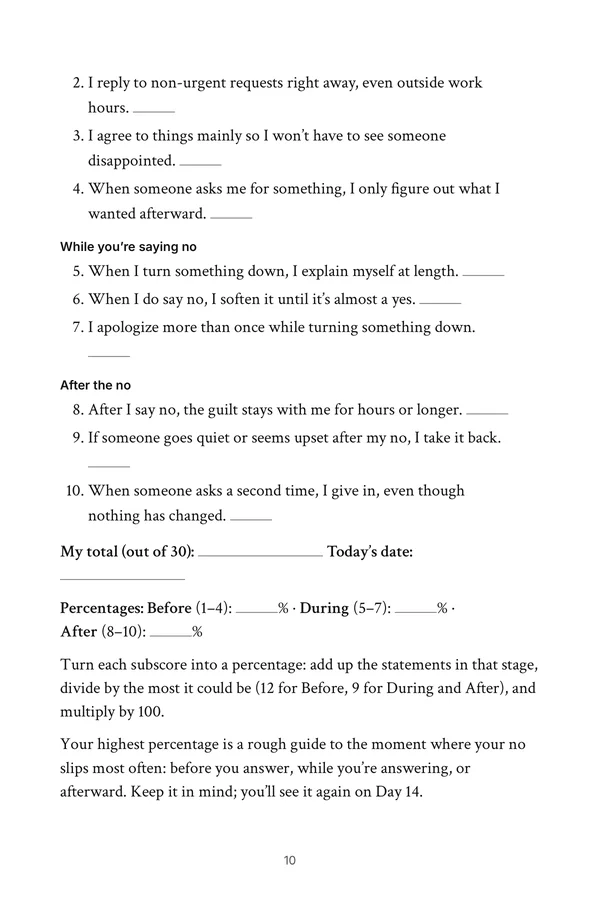
- A 10-question Pleasing Audit to measure Day 1 vs Day 14
- The pause rule: stop the automatic yes
- One-sentence nos — warm, short, no long explanation
- Scripts for work, family, and friends — plus how to undo a yes you regret
- A Script Bank and your personal Boundary List to keep after Day 14
Contents
- Before You Start
- Day 1 — The Pleasing Audit
- Day 2 — The Automatic Yes
- Day 3 — Guilt vs. Real Responsibility
- Day 4 — Your Boundary Map
- Part 1 Check-In
- Day 5 — The Pause Rule
- Day 6 — The One-Sentence No, on Safe Ground
- Day 7 — A Warm, Short No
- Day 8 — No at Work
- Day 9 — No with Family and Older Relatives
- Day 10 — Boundaries with Yourself
- Part 2 Check-In
- Day 11 — Three Ways Out of a Yes You Regret
- Day 12 — When They Punish You with Silence or Judgment
- Day 13 — The Small-Promises Ledger
- Day 14 — The Pleasing Audit, Again, and Your Weekly Rhythm
- When the No Happens by Text
- When You Live with the Person
- When You’re the Caregiver
- When You Manage Other People
- When You’re Not Sure It’s Okay to Say No
- Script Bank
- Week 1 — Try It
- Week 2 — Meet the Pushback
- Week 3 — Spot the Pattern
- Week 4 — On My Own
- My Boundary List
- What to Do Next
Read a little first
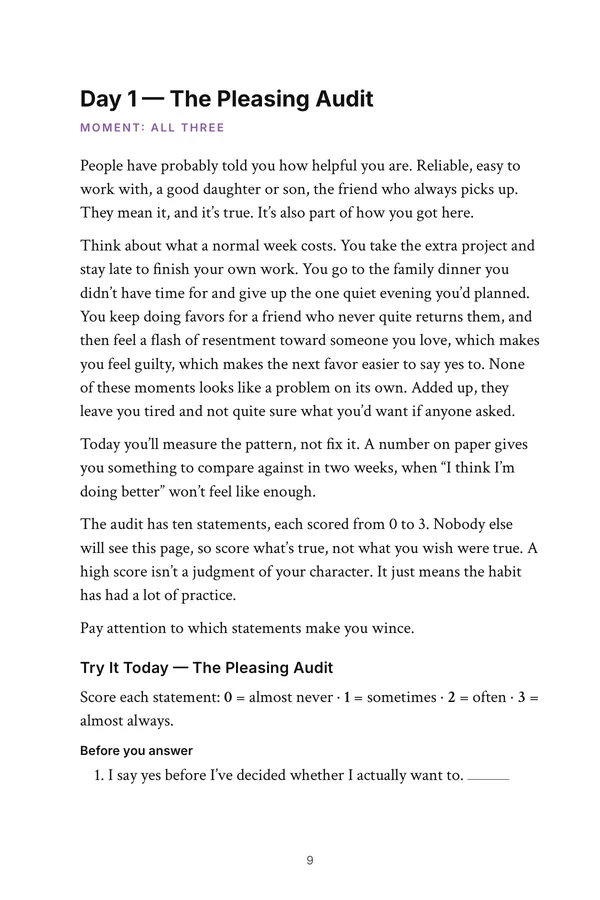
People have probably told you how helpful you are. Reliable, easy to work with, a good daughter or son, the friend who always picks up. They mean it, and it’s true. It’s also part of how you got here.
Think about what a normal week costs. You take the extra project and stay late to finish your own work. You go to the family dinner you didn’t have time for and give up the one quiet evening you’d planned. You keep doing favors for a friend who never quite returns them, and then feel a flash of resentment toward someone you love, which makes you feel guilty, which makes the next favor easier to say yes to. None of these moments looks like a problem on its own. Added up, they leave you tired and not quite sure what you’d want if anyone asked.
A look at the pages
From the free sample.