
Money & Work · Productivity · English · 107 pages
The Time You Actually Control
Stop Reacting. Start Choosing. Take Back the Hours That Matter.
by Alexia Le
Time management for people whose time isn't entirely their own: parents, caregivers, shift workers, and anyone whose day is decided by whoever calls first.
- ✓ Secure checkout by Stripe · card, Apple Pay and more
- ✓ Instant download: PDF + EPUB, any device
- ✓ File problem? Full refund within 7 days (policy)
About the book
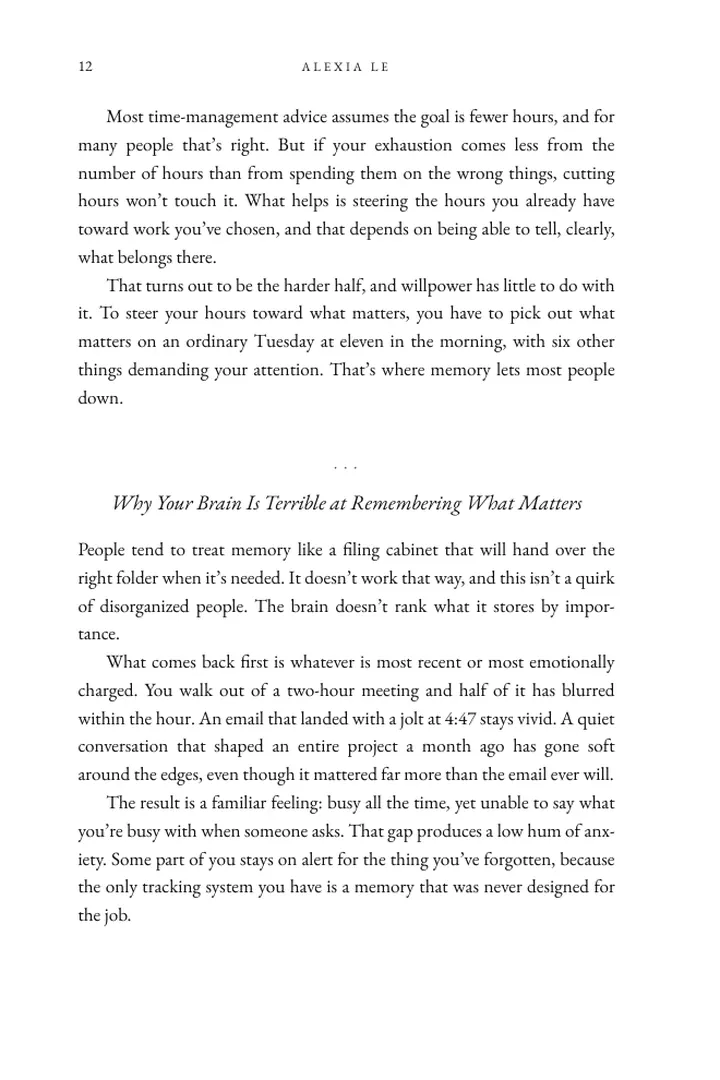
Most people buried by their schedules aren't lazy. They're holding everything in their heads, and memory hands you the loudest, newest thing first, whether or not it matters.
This book builds a simple system that holds your commitments outside your head, then tests it honestly against real constraints.
What's inside
- Build the whole system in four weeks, one layer at a time
- Stop letting your inbox set your priorities
- Keep going when your job is made of interruptions
- Adapt the tools for ADHD, anxiety, parenting, and your energy curve
- Rebuild quickly when life knocks the system over
Contents
- Before You Start
- Introduction: The Gap Nobody Names Directly
- Chapter One: What Actually Wears You Down
- Chapter Two: The Machinery Beneath a Working Day
- Chapter Three: What Keeps a System Alive
- Chapter Four: Building It in Four Weeks
- Chapter Five: When Your Time Isn’t Fully Yours
- Chapter Six: Different Minds, Different Hours
- Chapter Seven: Protecting Your Attention
- Chapter Eight: Other People, Other Clocks
- Chapter Nine: Where Your Hours Really Go
- Chapter Ten: Time, Money, and What to Hand Off
- Chapter Eleven: When It Breaks, and When It’s Enough
- Chapter Twelve: Where the System Stops
- Conclusion: The Hours That Matter
- Appendix: Worksheets
- Appendix: Where These Ideas Come From
- Appendix: How This Compares to GTD
- Appendix: Weekly Board Template
Read a little first
Most people who feel buried by their schedules aren’t lazy or undisciplined. They’re putting reasonable effort into a setup that was never built to carry what modern work and family life ask of it. Often there’s no setup at all, just a head full of reminders and a phone full of alerts.
The trouble isn’t time. Everyone gets the same twenty-four hours, and hearing that has never made anyone feel less overwhelmed. The trouble is attention and memory. Whatever you’re trying to hold in your head gets recalled by urgency and emotional volume rather than by importance, and the result is a steady, low-grade worry that something is slipping. Over enough weeks, something usually is.
A look at the pages
From the free sample.