Does Playing Hard to Get Work? What the Research Actually Says
By Alexia Le · November 27, 2026
You like him, and that is exactly the problem. Your instinct is to answer his message right away, say yes to Saturday, tell him you had a good time. Then the advice arrives, from a friend, an article, a video with a confident voiceover: wait a few hours before you reply. Be a little less available. Let him wonder.
So you sit with the phone face-down, counting minutes, performing a calm you do not feel. If it works, you are not sure what you won. If it does not, you wonder whether you waited long enough.
The question underneath is a fair one. Does playing hard to get actually work? Researchers have tested it, and the answer is more interesting than yes or no.
What the best-known study found
In 2014, Xianchi Dai, Ping Dong and Jayson Jia published a paper in the Journal of Experimental Psychology: General titled "When does playing hard to get increase romantic attraction?" Their abstract begins by noting that folk wisdom treats playing hard to get as effective, while "prior research has yielded little support for this belief."
According to a Stanford Graduate School of Business write-up of the work, the researchers recruited male undergraduates at a university in Hong Kong for what was presented as a speed-dating event. Each man met the same woman, who was working with the researchers. In one condition she was easy to get: she smiled and engaged in the conversation. In the other she was hard to get: she answered questions but kept a poker face, offering uncertainty and a mild negative signal.
The result splits attraction in two. Playing hard to get, the abstract says, can "simultaneously increase A's wanting but decrease A's liking of B." The men liked the hard-to-get woman less, yet some of them were more motivated to pursue her.
There is a catch that the popular advice leaves out. That effect appeared only when the man was already psychologically committed, in this study when he believed he had chosen her himself. Without that prior interest, the abstract reports, playing hard to get decreased both wanting and liking. One line in the Stanford article sums up the risk: "You risk winning the battle and losing the war."
So the honest summary looks like this:
- If he is not already interested, acting unavailable tends to make him less interested.
- If he is already interested, it can make him chase harder while liking you less.
- Neither outcome is the thing most people actually want, which is to be liked and chosen by someone who likes them back.
This was one research team and a specific group of young men, so it is not the final word on every relationship. But it is a useful correction to advice that is usually delivered as if it were a law of nature.
Being selective is not the same as being cold
The advice to play it cool usually grows out of a real observation: people who seem willing to settle for anyone are less appealing. Research supports a version of that idea, and it points somewhere different.
In a 2007 study in Psychological Science, Paul Eastwick and Eli Finkel of Northwestern University, with Daniel Mochon and Dan Ariely of MIT, ran speed-dating sessions with 156 undergraduates. Each person had four-minute dates with 9 to 13 people and rated each one. The researchers separated two kinds of desire: wanting one particular person more than others, and tending to want everyone.
The two worked in opposite directions. When someone uniquely desired a particular partner, that partner tended to return the interest. When someone desired nearly everyone, those others tended not to desire them back. As Eastwick put it in Northwestern's announcement, "romantic desire comes in two distinct flavors: selective and unselective."
Notice what this does and does not say. The people who did well were not distant or hard to read. They were warm toward someone specific. Interest that is clearly about this person, rather than about wanting anyone at all, is the kind that tends to be returned. In practice that means you can be openly glad to see him and still be someone with standards, preferences and a life that does not rearrange itself around his schedule.
Warmth keeps attraction alive later, too
Strategic distance is sometimes sold as a way to keep desire going in a long relationship. The research on established couples points the other way.
In a 2016 paper in the Journal of Personality and Social Psychology, Gurit Birnbaum and Harry Reis, with colleagues, ran three studies on how a partner's responsiveness relates to desire. A University of Rochester summary describes one part in which 100 couples kept a diary for six weeks. Across the studies, the abstract reports, "responsiveness was associated with increased desire, but more strongly in women." Responsive partners made people feel special and were seen as more valuable mates, which made them more desirable.
In Birnbaum's words, "partners who are responsive to each other outside the bedroom are able to maintain their sexual desire." Being attentive is not what drains attraction over time. Being unseen does.
What to do instead of the waiting game
If you have been holding back replies on a timer, the alternative is not to answer every message within thirty seconds and clear your weekend for him. It is to stop running your behavior from his reactions at all. A few ideas that follow from the research:
- Reply when you are actually free, not on a schedule. Real availability and real unavailability both read as honest. Calculated delays tend to read as a game, and some people will play it back.
- Let your interest be specific. Tell him what you enjoyed about the evening with him, rather than offering general enthusiasm that could be about anyone.
- Keep the parts of your life that were already full. Friends, work you care about, plans you made before he appeared. These are not tactics to make him miss you. They are what make you a person rather than a waiting room.
- Watch what he does with warmth. Someone who becomes more interested when you are cold and less interested when you are kind is giving you information about the relationship he wants.
- Notice the cost of performing. If staying cool takes constant effort and leaves you anxious, the strategy is costing you more than it is costing him.
The point is not that you should never pull back. Sometimes stepping back is the right decision, because someone is not giving you what you need. That is different from a performance designed to produce a reaction.
A different place to stand
The Woman He Cannot Possess starts where this research leaves off. Its premise is that you do not need to care less; you need somewhere else to stand. Drawing on attachment research, emotion regulation and studies of how couples fight and repair, it separates the useful metaphor of "feminine energy" from the behavior underneath, and shows how a full life makes a partner an addition rather than the missing piece. Inside, you will find:
- The difference between performing calm and living from it
- Exact words for stating a boundary, declining, and ending a relationship
- How to read secure, avoidant, and anxious partners
- When a relationship is worth fighting for, and when patience has done all it can
- A four-week plan and a self-scored check-in
You can read the free chapters at the top of this page and see whether the approach fits the way you think.
If a relationship leaves you feeling afraid, controlled or unsafe, that is not a dating-strategy problem. Reach out to someone you trust or to a counselor or other professional.
Keep reading
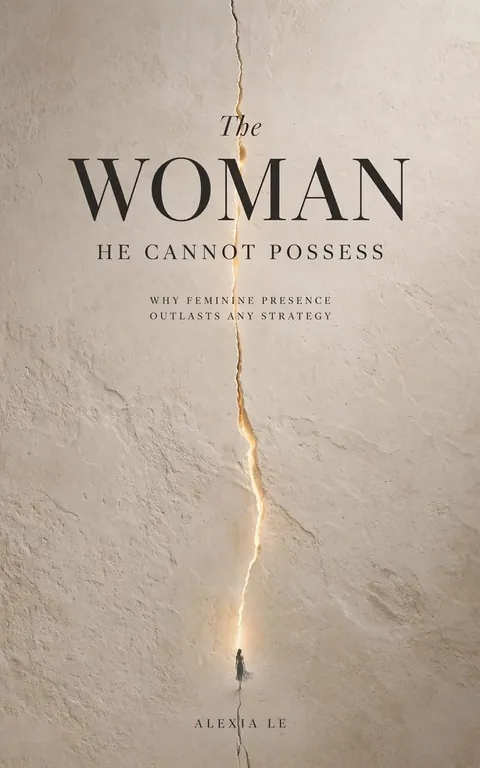
The Woman He Cannot Possess
Why Feminine Presence Outlasts Any Strategy
You don't need to care less. You need somewhere else to stand. A book about real self-possession, and why it can't be faked.
Sources
- Dai, Dong & Jia (2014), When does playing hard to get increase romantic attraction? Journal of Experimental Psychology: General 143(2), 521–526 (Stanford GSB publication page with abstract)
- Stanford Graduate School of Business: Jayson Jia, Does Playing Hard to Get Work? (2013)
- Eastwick, Finkel, Mochon & Ariely (2007), Selective versus unselective romantic desire: Not all reciprocity is created equal, Psychological Science 18(4), 317–319
- ScienceDaily (Northwestern University): Speed Dating Study: Selectivity Is Ultimate Aphrodisiac (2007)
- Birnbaum, Reis et al. (2016), Intimately connected: The importance of partner responsiveness for experiencing sexual desire, Journal of Personality and Social Psychology 111(4), 530–546 (PubMed)
- University of Rochester NewsCenter: Come on baby, (re)light my fire (2016)