Saying No Without the Long Explanation
By Alexia Le · November 25, 2026
The no itself is easy. It is one word. What makes it hard is everything that rushes in right after it: the explanation, the apology, the offer of a reason good enough to be accepted, the second reason in case the first one is not, and the promise to make it up later. By the time you have finished, the no has turned into a negotiation, and you have negotiated yourself into a yes.
Most people who struggle to say no do not struggle with the word. They struggle with the silence after it. This article is about that silence, and about how to let a short no stand.
Why the no feels harder than the yes
Saying yes is fast. It ends the awkward moment, pleases the person in front of you, and pushes the cost into the future, where it feels smaller. Saying no does the opposite. It creates a small awkward moment now, and the cost of the yes you avoided is invisible. No wonder the automatic answer is yes.
The cost is real, though, and it shows up in the body before it shows up in the calendar. The Mayo Clinic, in its guide to assertiveness, notes that being assertive "may especially help you reduce stress if you tend to take on too many responsibilities because you have a hard time saying no." The same guide describes what passive behavior can create inside: stress, resentment, seething anger, feelings of victimization, and doubting or questioning your own judgment.
Read that list slowly. It is a description of what a week of automatic yeses feels like from the inside. None of it is dramatic. It is the quiet accumulation of small agreements you did not want to make, and it is why a boundary problem rarely looks like one big decision. It looks like a hundred small ones.
Assertiveness is not aggression
A common fear is that saying no plainly will sound harsh. The Mayo Clinic draws the line clearly: assertiveness is a core communication skill that helps you express yourself effectively and stand up for your point of view, while respecting the rights and beliefs of others. It also notes that being assertive can boost your self-esteem and earn others' respect.
That distinction matters, because it tells you what to aim for. A good no is direct and respectful. It does not attack the other person, and it does not apologize for existing. "I can't take that on this week" is assertive. "I can't take that on this week, I'm so sorry, it's just that everything is crazy and I feel terrible about it, but maybe next month if you still need someone" is not more polite. It is a no that is begging to be overturned, and it usually is.
A short, calm no is easier for the other person to hear than a long, anxious one. You are not only protecting your own time. You are making the conversation easier for both sides.
The pause rule
The hardest no is the one you have to give on the spot. Someone asks in the hallway, in a meeting, at the dinner table, and the yes is out of your mouth before you have thought. The fix is not a better script. It is a pause.
Before you answer any request that is not an emergency, give yourself one sentence of delay: "Let me check and get back to you." Then actually check. Look at your calendar, your energy, and whether you want to do it. A yes that survives a night of thought is a real yes. A yes that only survives the three seconds after the question is not a decision. It is a reflex.
This is the first skill to practice, because it makes every other skill possible. You cannot choose a good no in the moment if you never give yourself a moment.
One sentence is enough
Once you have decided, keep the no to one sentence, and keep it warm. A warm no has three parts: the no, a brief acknowledgment of the person, and nothing else. "I can't take that on this week, but thank you for thinking of me." "I won't be able to make it, and I hope it goes well." That is the whole message.
The explanation is the trap. Every reason you add is a new thing the other person can argue with. If you say you are busy, they can solve your schedule. If you say you are tired, they can tell you it will not take long. If you say you have another commitment, they can ask when it ends. A reason is an opening. A short no closes the negotiation politely, and it does so precisely because there is nothing to argue with.
This does not mean you never explain. With people close to you, a sentence of context is often kind. The rule is simpler: explain once, briefly, because you want to, not because you need permission. If you find yourself adding a second reason, you have probably already said enough.
When they push back
Some people will not accept the first no. They will ask again, go quiet, or look disappointed. This is the moment the no actually gets tested, and it is the moment most people give in, because the discomfort feels like evidence that they did something wrong.
It is not evidence. Disappointment is a normal response to not getting what someone wanted. It is not proof that your no was unfair. The Mayo Clinic's advice on becoming more assertive starts with assessing your own style: do you say yes to additional work even when your schedule is full? If the answer is yes, the discomfort of holding the line is the cost of changing a pattern, not a sign that you should go back.
When pushback comes, repeat the same sentence, in the same tone. "I understand, and I still can't take it on." Repetition is not rudeness. It is consistency, and consistency is what teaches people that your no means no.
Undoing a yes you regret
Sometimes the yes has already escaped. You agreed on Tuesday and realized on Wednesday that you cannot do it. The longer you wait, the harder it gets, and the more the other person plans around you. So tell them early, plainly, and once: "I said yes too quickly, and I need to step back from this. I'm sorry for the change of plan."
A yes given in haste is a fair thing to withdraw, especially when you withdraw it in time for the other person to find someone else.
Going further
The No You Keep is a 14-day workbook built around exactly this sequence: see the pleasing pattern, practice saying no in small steps, then keep it when it gets hard. Each day is one short page, one writing exercise, and one script you can use right away. Inside, you will find:
- A 10-question Pleasing Audit to measure Day 1 against Day 14
- The pause rule: stop the automatic yes
- One-sentence nos — warm, short, no long explanation
- Scripts for work, family, and friends — plus how to undo a yes you regret
- A Script Bank and your personal Boundary List to keep after Day 14
You can start with the free chapters at the top of this page and see whether the approach fits the way you think.
If saying no feels impossible because a relationship is frightening or unsafe, this article is not the right tool. Reach out to someone you trust or to a professional for support.
Keep reading
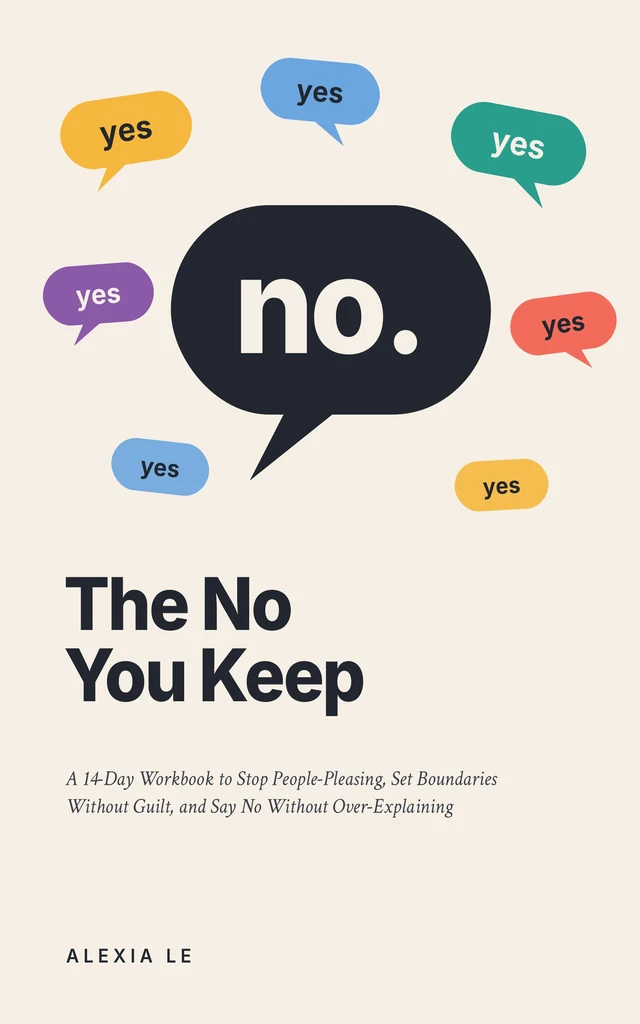
The No You Keep
A 14-Day Workbook to Stop People-Pleasing, Set Boundaries Without Guilt, and Say No Without Over-Explaining
Saying no is the easy part. This 14-day workbook teaches you how to hold your ground — when someone argues, gives you the silent treatment, or when you lie awake at night feeling guilty about it.