Small Money Habits That Compound
By Alexia Le · November 25, 2026
Most money advice fails in the same place: it asks for a dramatic change. A new budget, a new portfolio, a new personality. The change lasts a week, the old habits return, and the person concludes that they are bad with money. The problem was not the person. It was the size of the change.
The habits that actually build wealth are small enough to survive a bad week. They work not because any one of them is impressive, but because they repeat, and because time does the heavy lifting. The US Securities and Exchange Commission puts it plainly in its guide to saving and investing: "For most people, the best way to attain financial security is to save and invest over a long period of time."
The candy bar math
The SEC's own example is deliberately unglamorous. If you buy a candy bar every day for $1, it adds up to $365 a year. If you saved that $365 and put it into an investment that earns 5% a year, it would grow to $465.84 by the end of five years, and by the end of 30 years, to $1,577.50. The SEC calls this the power of compounding: "With compound interest, you earn interest on the money you save and on the interest that money earns. Over time, even a small amount saved can add up to big money."
Read those numbers again. Nobody got rich on a candy bar. The point is the shape of the curve. In five years, the money has grown by about a quarter. In thirty years, the same $365 has more than quadrupled. The difference is not the amount. It is the time.
The SEC gives a second version with coffee. A cup of coffee every day for $1.50 adds up to $547.50 a year. Saved for just one year and put into an account earning 5 percent a year, it would grow to $698.76 by the end of five years, and by the end of 30 years, to $2,366.26.
Both examples use 5 percent as an illustration, not a promise. No investment earns a steady 5 percent every year, and the examples do not account for taxes, fees, or inflation. They are useful anyway, because they show the mechanism: small amounts, saved regularly, left alone, grow in a way that feels slow at first and then stops feeling slow.
Why small beats dramatic
A dramatic money plan fails for the same reason a dramatic diet fails. It depends on willpower at exactly the moments when willpower is lowest: the end of a long day, the week the car breaks down, the month everything costs more than expected. A small habit survives those weeks because it does not ask much of them.
The SEC's advice follows the same logic. Its guide suggests making a rule for impulse buys, such as waiting 24 hours before buying anything, and watching where small everyday expenses add up over a year. The point is not to feel guilty about coffee. The point is to notice the leak before trying to fix it with a grand plan. A budget you can keep for ten years beats a perfect budget you keep for ten days.
Three small habits cover most of the ground:
- Pay yourself first, automatically. Move a fixed amount into savings on payday, before you can spend it, so the habit never depends on a decision made at the end of the month.
- Keep the amount small enough to survive a bad month. A habit you abandon in a hard month is worse than a smaller habit you keep.
- Review once a year, not once a week. Checking constantly invites tinkering, and tinkering is how small habits get undone.
Pay the expensive debt first
Before any of this, there is one step the SEC puts ahead of investing. Its guide states: "No investment strategy pays off as well as, or with less risk than, eliminating high interest debt." Most credit cards charge high interest rates, as much as 18 percent or more, if you do not pay off the balance in full each month.
The arithmetic is blunt. An investment earning 5 percent while a card charges 18 percent is not a plan. It is a leak with a hobby attached. Paying down high-interest debt is a guaranteed return in the only sense that matters: every dollar of interest you stop paying is a dollar you keep. That is why the SEC's keys to financial success list paying off high-interest debts before starting to save and invest.
This does not mean you must be debt-free before saving anything. An emergency cushion matters too. It means the expensive debt comes first in line, ahead of the clever investment, because the expensive debt is the thing quietly undoing the rest.
Saving is not investing
The SEC draws a careful line here, and it is worth keeping. Saving is money you earn but do not spend, usually put in safe places that allow access at any time: savings accounts, checking accounts, certificates of deposit. Investing is trying to make the money you earn grow, and when you invest, you have a greater chance of losing your money than when you save. Money invested in securities, mutual funds, and similar investments is typically not federally insured, and you could lose your principal.
That is not a reason to avoid investing. It is a reason to match the tool to the job. Money you will need soon, or cannot afford to lose, belongs in savings. Money for a goal years away can take more risk, because it has time to recover from a bad year. The mistake is to treat the two as the same thing: either keeping everything in cash and watching inflation eat it, or putting money you need next month into something that can fall.
Diversification is the SEC's shorthand for the same idea: "Don't put all your eggs in one basket." It does not remove risk. It spreads it, so that no single failure decides the outcome.
Your quiet number
The hardest question in money is not how to invest. It is how much is enough. Without an answer, every amount feels too small, and saving feels like a treadmill with no end. With an answer, the habit has a destination, and you can tell when you are on track.
Quietly Rich is built around that question. It is a guide to simple, unglamorous money decisions that actually compound, drawing on decades of research, from S&P's SPIVA scorecards to behavioral economics. Inside, you will find:
- Choose a simple, low-cost portfolio, in one fund or three
- Automate saving and investing so it never depends on willpower
- Write a one-sentence downturn policy that protects you from panic-selling
- Calculate your Quiet Number: how much is actually enough
- Handle windfalls, irregular income, a late start, and a partner who sees risk differently
You can start with the free chapters at the top of this page and see whether the approach fits the way you think.
This article is general information, not financial advice. Investment returns are not guaranteed, and the examples above are illustrations, not predictions. If your situation is complicated, talk with a qualified financial adviser before making big decisions.
Keep reading
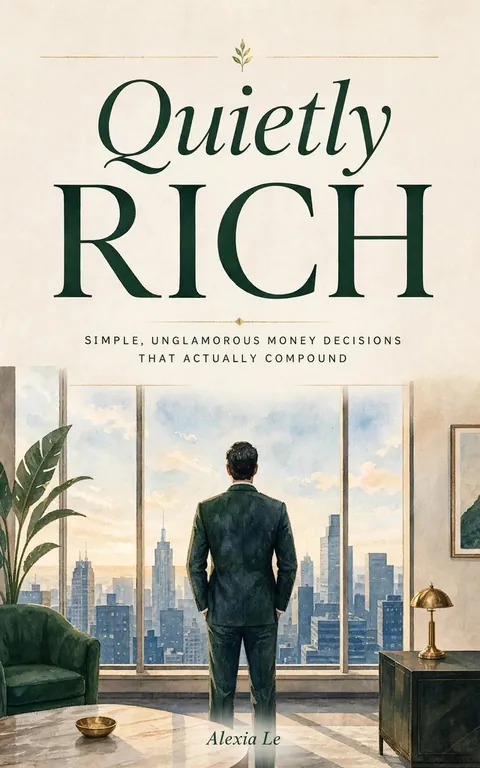
Quietly Rich
Simple, Unglamorous Money Decisions That Actually Compound
The people who build wealth quietly make a handful of plain decisions early, and then refuse to undo them. This book shows you exactly what those decisions are.